



A chair choice usually looks simple until people start using it eight hours a day. Then the wrong pick shows up fast – sore backs, poor posture, staff complaints, and a workspace that looks the part but does not perform. When clients ask us about task chairs vs executive chairs, the real question is usually not which one is better overall. It is which one is better for the way the space actually works.
For office managers, business owners, and project teams planning a fit-out, that distinction matters. Seating affects comfort, productivity, space planning, and budget. It also affects how consistently a workplace performs across private offices, open-plan workstations, meeting rooms, reception zones, and home offices.
Task chairs vs executive chairs: the core difference
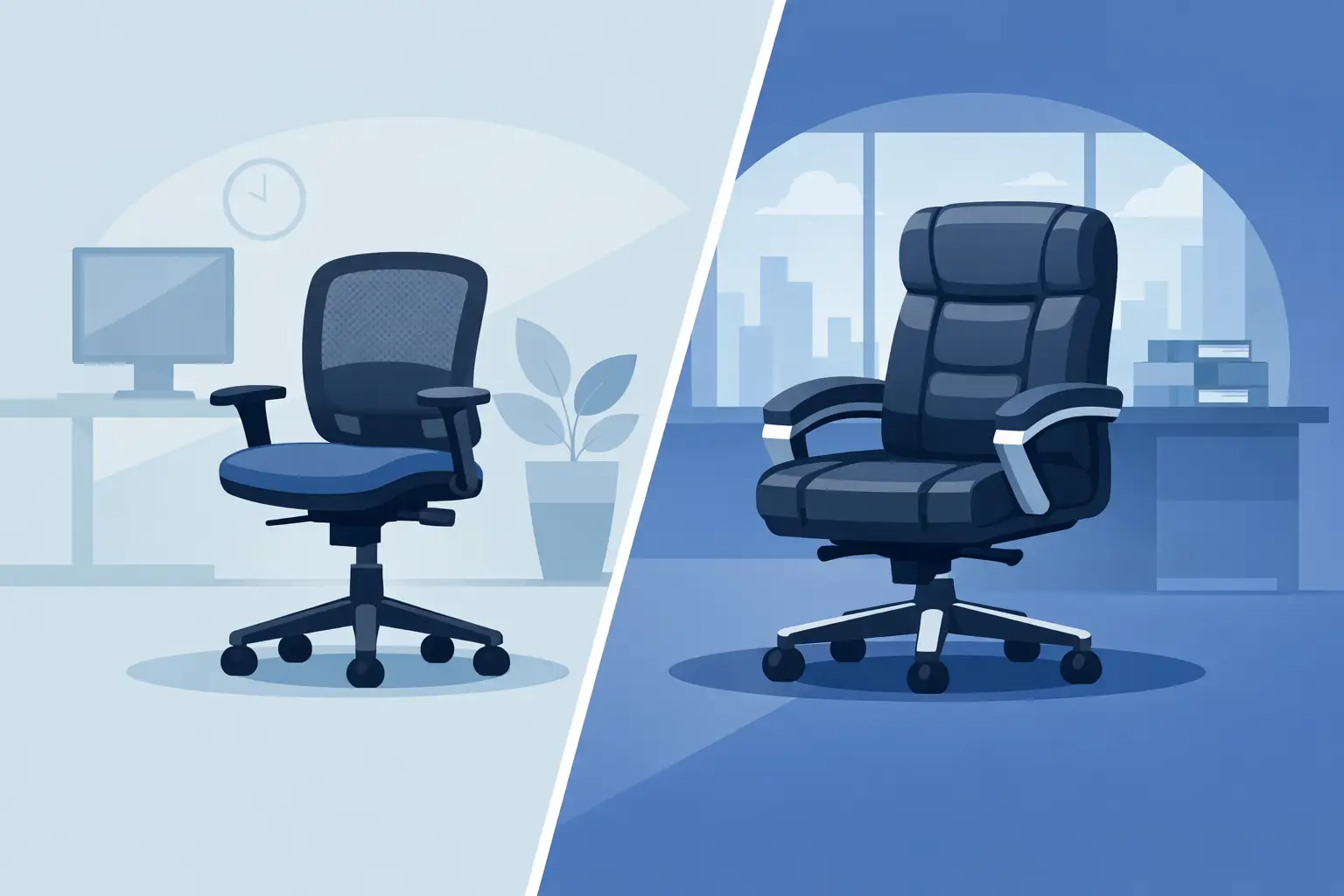
A task chair is built for active desk work. It is usually lighter in profile, more adjustable, and designed to support movement through the day. You will commonly see task chairs at workstations, shared desks, and operational roles where people spend long periods typing, turning, reaching, and shifting position.
An executive chair is built to deliver a more substantial visual presence and a more cushioned sitting experience. It often has a higher back, broader seat, and more upholstered finish. These chairs are typically chosen for private offices, leadership spaces, and environments where appearance carries as much weight as day-to-day function.
That does not mean task chairs are plain or low quality, and it does not mean executive chairs are automatically more comfortable. The better option depends on who is using the chair, for how long, and in what kind of workspace.
Where task chairs usually perform better
If your priority is ergonomic support across a wide range of users, task chairs usually have the advantage. A good task chair is designed to fit the person rather than forcing the person to fit the chair. That matters in modern offices where workstations are used by different staff, teams hot-desk, or a business wants consistency across multiple roles.
Task chairs often provide more precise adjustments for seat height, seat depth, lumbar support, back angle, and arm position. Those details are not minor. They are what allow a chair to support neutral posture and reduce the strain that builds up over a full workday.
They also tend to work better in tighter footprints. In open-plan layouts, space efficiency matters. A slimmer chair profile helps maintain circulation, keeps workstation rows cleaner, and avoids the heavy visual clutter that bulky seating can create.
For operational teams, call centers, administration staff, designers, coordinators, and home office users doing focused computer work, task chairs usually make more sense. They are purpose-built for daily use, repeated movement, and practical ergonomic outcomes.
Why adjustability matters more than padding
One of the most common assumptions in office seating is that thicker cushioning means better comfort. In practice, comfort over ten minutes and comfort over ten hours are not the same thing.
A chair with generous padding may feel impressive at first sit, but if it lacks proper lumbar support, arm adjustment, or seat depth control, that comfort can drop off quickly. A task chair with the right ergonomic setup often outperforms a heavier chair simply because it supports posture more accurately.
For businesses investing in staff wellbeing or trying to reduce discomfort-related complaints, adjustability is usually the feature that delivers the strongest return.
Where executive chairs make more sense
Executive chairs are often the right choice when leadership offices need a stronger design statement or when a user prefers a more enveloping seat. In a private office, a high-back executive chair can help define the space. It signals seniority, adds finish to the room, and pairs well with more refined joinery, boardroom-style desks, and client-facing environments.
They can also suit users who spend part of the day at the desk and part of the day in calls, reading, or informal discussions. The broader frame and taller back can feel more relaxed in those settings.
That said, executive chairs vary widely. Some are genuinely ergonomic and well-engineered. Others are mostly aesthetic, with limited support once the workday gets long. That is why specification matters. If a chair is going into a managing director’s office, a medical practice administration office, or a developer’s project suite, it should still be assessed on support and fit, not just finish.
The trade-off with executive seating
The main trade-off is that executive chairs are often less adaptable across multiple users. Their dimensions may suit one person well but not another. In shared environments, that can become a problem. A chair that looks appropriate in a private office may be harder to standardize across a broader team.
They also take up more visual and physical space. In a compact office, several executive-style chairs can make the layout feel crowded. If your floor plan is already working hard, bulkier seating may reduce flexibility more than expected.
Cost, longevity, and value
Price comparisons between task chairs and executive chairs can be misleading because the category name does not tell you much on its own. There are entry-level task chairs and premium ergonomic task chairs. There are budget executive chairs and high-spec executive models with excellent support.
What matters is value over time. A chair used every workday is not a decorative purchase. It is an operating asset. If lower-cost seating leads to discomfort, poor durability, or early replacement, it was never the cheaper option.
Task chairs often deliver stronger long-term value in larger rollouts because they are easier to standardize, easier to fit across different body types, and generally more aligned with workstation ergonomics. Executive chairs can still justify the investment in the right setting, especially where client presentation, office hierarchy, or interior consistency is part of the brief.
For procurement decisions, it helps to assess seating the same way you would assess workstations or joinery – by use case, expected lifespan, user profile, and maintenance demands.
What to choose for different spaces
In open-plan offices, task chairs are usually the clear choice. They support movement, fit workstation layouts more efficiently, and allow better ergonomic consistency across teams. If the office includes sit-stand desks, task seating is generally the stronger match.
In private offices, the answer depends on how the room is used. If the person spends most of the day on focused computer work, a high-performance task chair may still be the better solution. If the office is more client-facing or used for a mix of desk work and meetings, an executive chair may be appropriate.
For boardrooms, neither category always fits perfectly. Many boardroom chairs lean toward executive styling, but they should still support posture for longer meetings. For home offices, task chairs often outperform executive chairs because they are more adaptable and better suited to daily workstation use.
In medical and specialist administration environments, practical ergonomics usually matter more than image. Staff working in reception, records, scheduling, or consulting support roles typically benefit from task chairs that can be adjusted properly and cleaned easily.
How to decide without overbuying or underspecifying
The easiest mistake is choosing chairs based on appearance alone. The second easiest is treating every seat in the project the same. Most workplaces need a mix.
Start with the role, not the room title. Ask how many hours the person spends seated, what type of work they do, whether the chair is shared, and how much adjustment is needed. Then look at the overall design language of the space so the seating supports the fit-out rather than fighting it.
This is where a coordinated approach makes a difference. When furniture selection, layout planning, and fit-out execution are handled together, the chair decision becomes more accurate. You are not choosing from a catalog in isolation. You are selecting seating that works with the desks, the room sizes, the user needs, and the broader project budget.
Absolute Office Comforts works with clients this way because office seating is rarely just a product decision. It is part of how the workplace functions day to day.
The better question than task chairs vs executive chairs
The better question is not which category sounds more premium. It is which chair supports the people using the space and matches the way the environment is meant to operate.
A well-specified task chair can outperform an executive chair in comfort, productivity, and durability. A well-chosen executive chair can add authority and finish where that matters. The right answer depends on the user, the layout, and the standard you want the workplace to meet.
If you are fitting out a new office or upgrading an existing one, treat seating as part of the larger plan. The chair someone sits in every day has a direct effect on how the whole workspace feels and performs.