



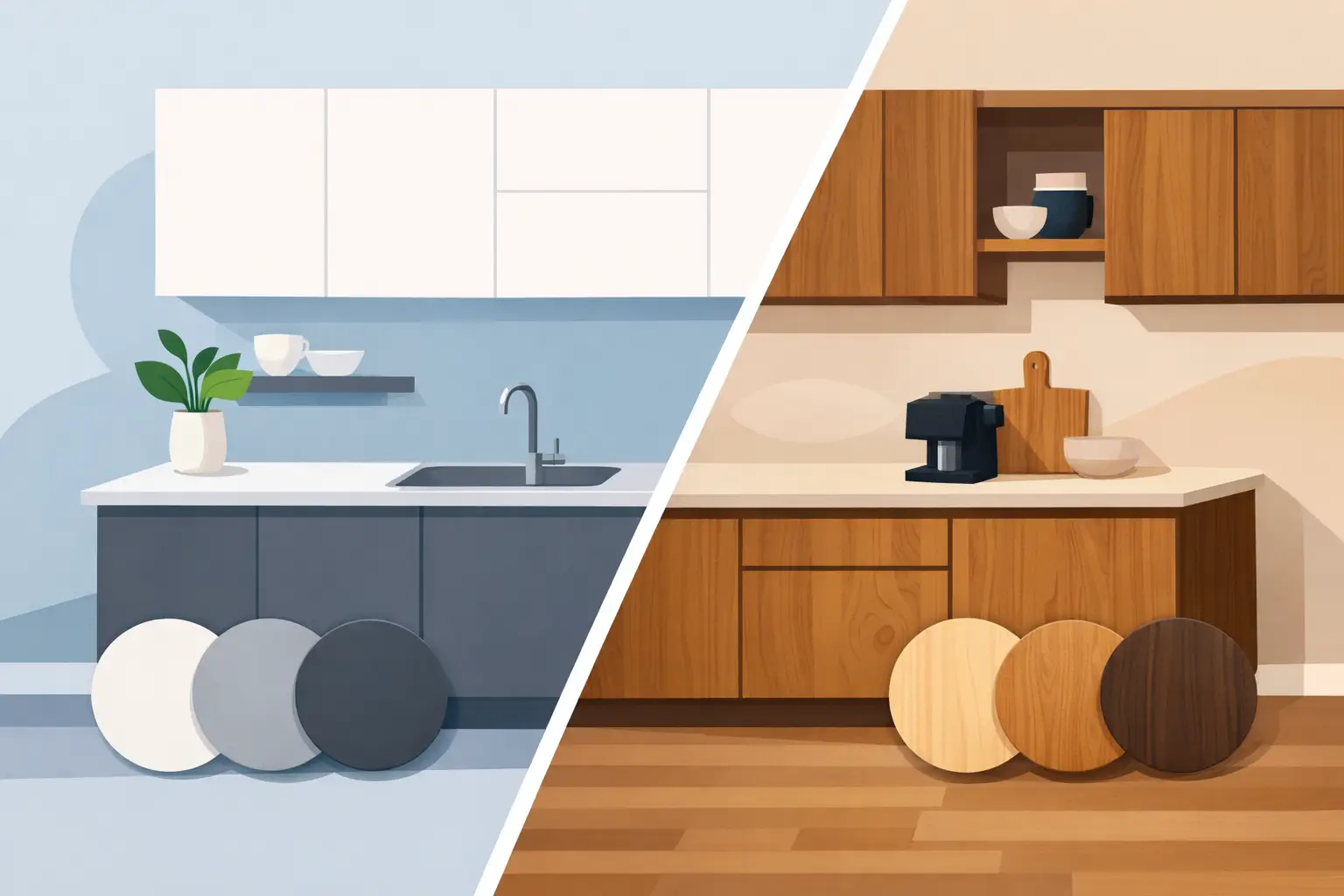
A reception counter is touched hundreds of times a week. A staff kitchenette faces heat, spills, and cleaning chemicals. In a home kitchen, cabinet doors are opened, bumped, and wiped down every day. That is why laminate versus timber cabinetry is not simply a question of appearance. It is a decision about how a space will perform, what it will cost to deliver, and how well it will stand up to the people using it.
For office fit-outs, medical practices, hospitality spaces, and residential renovations, both materials can produce excellent results. The right specification depends on the application, the desired finish, the project budget, and the level of maintenance the client is prepared to accept.
Laminate Versus Timber Cabinetry: The Core Difference
Laminate cabinetry generally uses a manufactured board substrate, such as particleboard or MDF, finished with a decorative, protective laminate surface. This surface can replicate timber grain, stone, solid colors, concrete, or other contemporary finishes. It is widely used for office workstations, storage units, kitchens, reception desks, and commercial joinery because it offers consistency, durability, and a broad range of design options.
Timber cabinetry can refer to solid timber, timber veneer over a board substrate, or a combination of both. Solid timber provides natural grain, depth, and variation that cannot be fully duplicated. Veneer uses a thin layer of real timber over a stable core, delivering much of the visual character of solid timber while using the material more efficiently.
The distinction matters. A laminate that looks like oak and an oak veneer may appear similar from across a room, but they will age differently, feel different to the touch, and respond differently to damage, moisture, and refinishing.
When Laminate Is the Practical Choice
Laminate is often the strongest option where performance, budget control, and repeatability matter most. In a large office, for example, matching dozens of workstations, cabinets, and meeting room credenzas is far more straightforward with a specified laminate finish. It provides a uniform result across the entire project.
Built for high-use spaces
Quality laminate surfaces are well suited to areas that receive regular contact. They resist everyday scratching, staining, and moisture better than many natural timber finishes, particularly when paired with well-made edges and durable hardware. This makes laminate a sensible choice for staff kitchens, medical storage, education spaces, office tea points, and commercial cabinetry.
The key qualification is edge detailing. The face of a laminate panel may perform well, but damaged or poorly sealed edges can allow moisture into the substrate. In wet or high-cleaning areas, material selection, edge treatment, and installation quality must work together.
More control over cost and program
Laminate cabinetry is generally more economical than solid timber and often less costly than premium veneer joinery. It can also support faster manufacturing and installation programs because the finish is selected upfront rather than applied and cured as part of the production process.
For facility managers and developers, this predictability is valuable. A clear finish schedule helps control procurement, keeps replacement components consistent, and reduces surprises during a staged refurbishment.
A wider finish palette
Laminate is no longer limited to basic white cabinets or imitation woodgrain. Current ranges include textured timber looks, matte neutrals, deep charcoal finishes, soft-touch surfaces, and durable solid colors. This allows a business to carry its interior palette from reception and meeting rooms through to storage and staff areas without relying on multiple materials.
For a modern office or medical fit-out, laminate can create a crisp, professional look while keeping the project practical. It is particularly effective when the design calls for clean lines, integrated storage, and repeatable modules.
Where Timber Adds Value
Timber cabinetry is chosen for character. Every real timber surface has grain movement, tonal variation, and a tactile quality that gives a space warmth. In executive offices, premium boardrooms, boutique medical practices, high-end kitchens, and residential home offices, that natural detail can make the joinery feel more considered and permanent.
Natural variation is part of the finish
With timber, no two panels are identical. For many clients, that is the point. A timber veneer reception desk or a solid timber kitchen feature can soften a commercial environment and create a strong first impression.
It also means expectations need to be set correctly. Samples are a guide, not an exact promise of grain pattern or tone. Natural materials can change slightly with light exposure and age, and this should be allowed for in the design process.
Repair and longevity considerations
Solid timber can often be sanded, repaired, and refinished after years of use. Veneer can also be repaired in some circumstances, although its thin timber layer gives less scope for aggressive sanding. This can make timber a compelling long-term investment in feature pieces that are expected to remain in place for many years.
However, timber requires more care than laminate. It can be marked by sharp impacts, affected by standing water, and altered by heat or direct sun. Protective coatings improve performance, but they do not make natural timber maintenance-free.
Best used where it will be noticed
Timber does not need to be used everywhere to be effective. A practical approach is to place it at visible touchpoints: a reception counter front, a boardroom credenza, open shelving, a kitchen island, or a residential study desk. The less visible cabinet interiors and high-abuse storage areas can then use complementary laminate.
This mixed-material approach gives the project a premium appearance without placing a high-maintenance finish in every location.
Compare Performance Before Choosing a Finish
A material decision should follow the way the cabinetry will be used, not just a mood board. In busy shared environments, durability and cleaning requirements should carry real weight. In client-facing areas, the visual impact of timber may justify a higher spend.
Laminate usually has the advantage for everyday stain resistance, routine cleaning, and budget certainty. Timber usually has the advantage for authenticity, visual depth, and the ability to create a more individual finish. Neither is automatically better.
For example, a workplace kitchenette may need laminate doors and benchtop-facing cabinetry because staff use it constantly. A nearby breakout area might incorporate timber-look laminate for continuity, while the main reception desk uses timber veneer to establish a more refined arrival experience. The materials are selected according to their job.
Design Details Matter as Much as Material
Cabinetry performance is never determined by surface finish alone. The board substrate, hardware, hinges, drawer runners, edge profiles, ventilation, wall fixing, and installation all affect the final result.
A poorly planned laminate cabinet can fail prematurely, just as a well-designed timber veneer unit can deliver years of reliable service. Moisture-prone areas need appropriate substrates and detailing. Heavy storage needs suitable load-bearing construction. Doors and drawers in high-use zones need commercial-grade hardware that can tolerate repeated operation.
For custom cabinetry, it is also worth considering how future changes will be handled. Can damaged doors be replaced? Will the selected finish still be available if an office expands? Is the cabinetry designed around existing services, access requirements, and workflow? These questions are particularly relevant in medical fit-outs and commercial refurbishments, where downtime and disruption need to be managed carefully.
Making the Right Choice for Your Project
Start with the space, not the finish sample. Consider who will use the cabinetry, how frequently it will be cleaned, whether it is exposed to moisture or heat, and how long it needs to serve the business or household. Then balance those requirements against the visual standard the space needs to achieve.
At Absolute Office Comforts, material selection forms part of the broader planning process. Because cabinetry can be designed, manufactured, and installed as part of a complete fit-out or renovation, decisions about laminate, timber, veneer, hardware, and layout can be coordinated before production begins. That helps avoid the common problem of choosing an attractive finish that is not suited to the operational demands of the space.
The most successful projects rarely treat laminate and timber as opposing camps. They use each material where it delivers the most value. Choose laminate where resilience, consistency, and efficient delivery matter. Choose timber where natural character and long-term visual impact deserve the investment. A well-specified combination can give a workplace or home the right balance of performance, warmth, and lasting quality.