



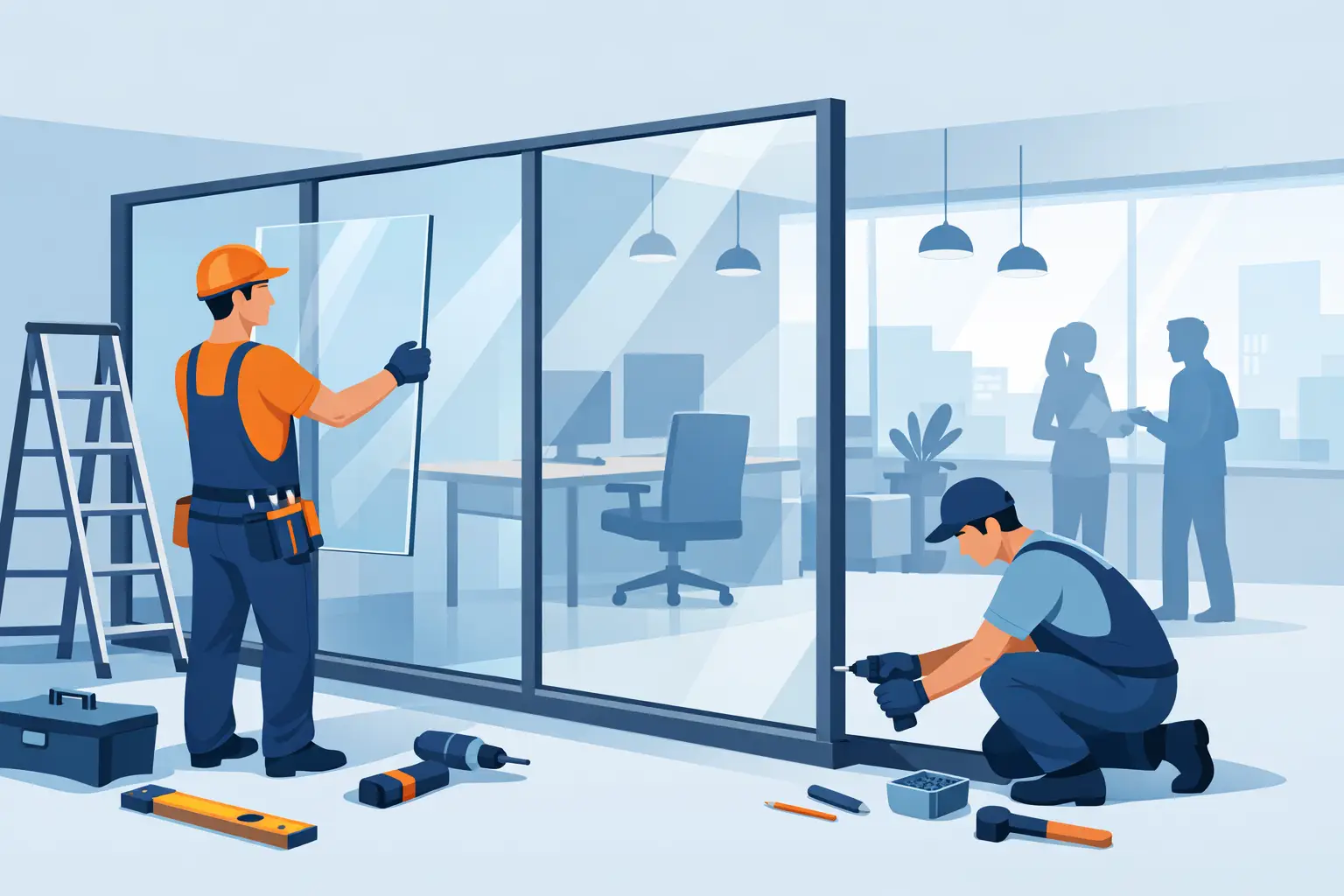
A cramped open office usually shows its problems before anyone says a word. Noise carries across teams, private calls spill into shared space, and departments that need focus end up competing with each other for quiet. Office partition wall installation solves more than a space problem. Done properly, it gives a workplace structure, improves how teams work, and creates room for growth without forcing a full relocation.
For business owners, office managers, and facilities teams, the real question is not whether partitions can divide a room. It is whether the installation will support workflow, meet building requirements, stay on budget, and still look consistent with the rest of the fit-out. That is where planning matters.
Why office partition wall installation matters
Partition walls are often treated as a finishing item, but they affect the function of the entire office. The placement of meeting rooms, manager offices, quiet zones, reception areas, and collaborative spaces all depends on how walls define movement and visibility.
A well-planned installation can improve acoustic control, create better privacy for HR or finance functions, and make an office feel more intentional. In medical settings, partition walls can also support patient flow, consultation privacy, and compliance with operational requirements. In commercial offices, they help separate teams without closing the space down completely.
There is also a financial angle. Compared with major structural building work, partition systems can be a faster and more cost-effective way to reconfigure an existing footprint. That makes them practical for growing businesses, leasehold upgrades, and refurbishment projects where timelines matter.
Choosing the right partition wall system
Not every office partition wall installation should use the same material or construction method. The right choice depends on how the space is used, how permanent the layout needs to be, and what level of privacy or sound control is required.
Glass partitions
Glass partitions work well where natural light and visual openness matter. They are common in boardrooms, private offices, and reception-facing spaces because they keep the workplace feeling larger while still creating separation. Frosted or partially frosted sections can add privacy without sacrificing light.
The trade-off is acoustic performance. Standard glass partitions can reduce noise, but they are not always the best option for highly confidential environments unless the specification is upgraded. If speech privacy is critical, framing details, seals, and glazing type become important.
Solid plasterboard or drywall partitions
Solid partition walls are often the practical choice for spaces that need stronger acoustic separation or a more conventional enclosed-room feel. They suit executive offices, consultation rooms, storage areas, and utility spaces. They also offer flexibility for paint finishes, mounted shelving, cabinetry, and integrated services.
These systems can be highly effective, but they need to be coordinated with electrical, data, HVAC, and fire requirements from the start. Cutting that coordination late in the project usually costs time and money.
Demountable and modular systems
For businesses expecting future changes, modular partitions can make sense. These systems are designed to be reconfigured more easily than fixed construction, which is useful in leased offices or workplaces that regularly adjust team layouts.
They may carry a higher upfront cost depending on the system, but they can reduce future disruption when a business expands or restructures. Whether that value stacks up depends on how likely layout changes are over the next few years.
What to plan before installation starts
The success of office partition wall installation is usually decided before any materials arrive on site. A clean-looking finish is one thing. A layout that actually works for the business is another.
The first step is understanding how the office operates day to day. Which teams need quiet? Which roles need private meeting space? Where do people move most often? A layout that looks efficient on paper can still create bottlenecks if it ignores how staff and visitors actually use the space.
Budget is the next piece, but it should be tied to outcomes rather than treated as a number in isolation. Saving money by reducing acoustic performance or skipping integrated services can create an office that needs fixing almost immediately. On the other hand, overspecifying every room is not always necessary. A good fit-out approach matches the wall system to the purpose of each area.
Approvals and compliance also need attention early. Depending on the site, office partition wall installation may involve building approvals, landlord requirements, fire regulations, accessibility considerations, and service modifications. This is especially relevant in medical, commercial, and multi-tenant buildings where standards are stricter and delays can affect move-in dates.
How the installation process typically works
A professional installation process should feel controlled, not improvised. That starts with a proper site measure and a clear review of existing conditions. Floor levels, ceiling types, service locations, access constraints, and wall junctions all affect how easily partitions can be installed.
From there, the design and documentation stage should lock in the layout, wall types, door positions, finishes, and service coordination. This is where experienced project management adds value. If electrical and data points are not coordinated with partition locations, trades end up working around each other instead of in sequence.
Once materials are confirmed, site preparation begins. In an occupied office, this may require staged works, after-hours access, dust control, and temporary relocation planning. In a vacant tenancy, the process is more straightforward, but site sequencing still matters if flooring, ceilings, joinery, and furniture installation are part of the same program.
Installation itself usually includes wall framing or system setup, service rough-in, sheeting or glazing, finishing, door hardware, and final adjustments. The exact sequence depends on the partition type. Quality control at this stage is not just about straight lines. It includes door operation, seal performance, alignment with ceilings and floors, and consistency with the wider fit-out.
Cost factors that affect office partition wall installation
Clients often ask for a square-foot or square-yard rate, but partition installation costs are rarely that simple. Material choice is one factor, but layout complexity can have just as much impact.
A straight run of standard walls is very different from a project with multiple offices, glazed sections, custom doors, integrated blinds, access control, and service rerouting. Ceiling height also affects cost, as do acoustic requirements and the condition of the existing site.
There is also a difference between product cost and project cost. A partition wall may look affordable on its own, but once demolition, patching, approvals, electrical work, and finishing are added, the real budget becomes clearer. That is why detailed scoping at the front end matters. It prevents a low initial number from turning into a series of variations later.
For many businesses, the most cost-effective route is not the cheapest installation. It is the solution that fits the office properly the first time and avoids unnecessary rework.
Common mistakes to avoid
The biggest mistake is treating partitions as isolated construction items instead of part of a larger workplace strategy. Walls influence acoustics, movement, privacy, furniture placement, and lighting. If they are designed without considering those elements, the office can end up feeling disjointed.
Another common issue is underestimating future change. A layout that works for today but leaves no room for team growth, technology changes, or operational shifts can become restrictive very quickly. This does not mean every office needs modular walls, but it does mean forward planning should be part of the brief.
Poor contractor coordination is another avoidable problem. Office partition wall installation often sits in the middle of several trades, and delays in one area can affect the entire schedule. Working with a provider that can manage design, manufacturing, installation, and fit-out coordination reduces that risk. For clients who want one point of accountability, that integrated approach can save significant time and disruption.
When a full-service partner makes the process easier
For office managers and business owners, the challenge is rarely just choosing a wall type. It is managing the moving parts around it. Design decisions, compliance, site access, furniture integration, and project timing all need to line up.
That is where a full-service fit-out partner can make a measurable difference. When the same team handles planning, custom manufacturing, installation, and project management, there is less fragmentation and fewer handover gaps between suppliers. Absolute Office Comforts works in that space because clients often need more than a wall installer. They need a workplace solution that fits operations, brand standards, and long-term use.
The best office partition wall installation is not the one that simply divides a room. It is the one that makes the entire workplace work better from the day staff move in.